Poker Bankroll Management: Full Guide
Master poker bankroll management with proven strategies, buy-in requirements, and tracking methods. Protect your bankroll long-term.
TryBluff Team · 2026-02-08
Poor bankroll management is the #1 reason most poker players go broke—even winning players. You can have world-class poker skills, but without proper bankroll management, variance will eventually catch up with you.
The good news? Bankroll management is simple to learn and implement. In this comprehensive guide, you'll discover the exact strategies that professional players use to protect their bankrolls while maximizing long-term profitability.
Whether you're grinding $1/$2 cash games or playing $200 buy-in tournaments, the principles remain the same: play within your means, track every session, and let the math work in your favor.
Bankroll management is the foundation under every other study area. Read it alongside the complete poker strategy guide, and use the cash game strategy pillar for stake-specific buy-in math.
Table of Contents
- What is Poker Bankroll Management?
- Why Bankroll Management Matters
- The Three Core Principles
- Buy-In Requirements by Game Type
- Cash Games vs Tournaments
- When to Move Up or Down in Stakes
- How to Track Your Bankroll
- Common Bankroll Mistakes
- Advanced Bankroll Strategies
- Frequently Asked Questions
What is Poker Bankroll Management?
Poker bankroll management (BRM) is the practice of controlling how much money you risk in poker games relative to your total available poker funds. It's a disciplined approach that ensures you can weather downswings without going broke.
Your bankroll should be:
- Separate from personal finances - Never risk money you need for rent, bills, or living expenses
- Dedicated to poker only - This isn't your general savings account
- Sufficient for your stakes - Large enough to absorb natural variance
Think of your bankroll as your poker business capital. Just as a business needs operating capital to survive slow periods, your bankroll needs to be large enough to survive losing streaks—which will happen, even to winning players.
The Key Concept: Risk of Ruin
The mathematical foundation of bankroll management is Risk of Ruin (RoR)—the probability you'll lose your entire bankroll before recovering.
With proper bankroll management, you keep your RoR below 5%. This means you have a 95%+ chance of never going broke, assuming you're a winning player.
Why Bankroll Management Matters
The Hard Truth About Variance
Even if you're a winning player with a 20% ROI in tournaments or a 5bb/100 win rate in cash games, variance can create massive swings in the short term.
Real-world example: A professional tournament player with a 25% ROI might experience:
- 50-tournament downswing where they lose 40% of their bankroll
- 100+ tournaments without a significant win
- Variance swings that feel like bad luck but are statistically normal
Without adequate bankroll management:
- ❌ You'll be forced to move down during downswings (playing scared money)
- ❌ You'll experience psychological stress that affects your play
- ❌ You'll lose confidence and start making poor decisions
- ❌ You'll eventually go broke even if you're a winning player long-term
With proper bankroll management:
- ✅ You can absorb downswings without stress
- ✅ You maintain confidence knowing variance will even out
- ✅ You make better decisions without desperation
- ✅ You maximize long-term profit by staying at appropriate stakes
The Psychology Factor
Bankroll management isn't just about math—it's about peace of mind. When you're properly bankrolled:
- You play your A-game because you're not afraid of losing
- You make correct folds in marginal spots instead of gambling
- You can take calculated risks without fear
- You sleep better at night
Playing scared money (under-bankrolled) is one of the fastest ways to become a losing player, even if you have the skills to win.
The Three Core Principles
1. Never Risk More Than You Can Afford to Lose
Your poker bankroll should be money you can afford to lose without affecting your lifestyle. This is recreational capital, not your emergency fund or rent money.
Rule of thumb: If losing your bankroll would cause financial hardship, you don't have a bankroll—you're gambling with money you can't afford to lose.
2. Maintain Adequate Buy-Ins for Your Stakes
The fundamental rule of bankroll management is maintaining enough buy-ins to absorb natural variance.
Minimum thresholds:
- Cash games: 20-30 buy-ins (conservative: 50)
- Sit & Go tournaments: 50-100 buy-ins
- Multi-table tournaments (MTTs): 100-200+ buy-ins
These numbers exist because they statistically protect you from ruin during even the worst downswings.
3. Track Every Session
You can't manage what you don't measure. Tracking every session allows you to:
- Calculate your true win rate
- Identify your most profitable game types
- Recognize when you're on tilt
- Make data-driven decisions about moving up or down
What to track:
- Date and time
- Location (online or live venue)
- Game type (NLH, PLO, tournaments, etc.)
- Stakes played
- Buy-in amount
- Cash-out amount
- Profit/loss
- Hours played
- Notes (opponents, key hands, mental state)
Try TryBluff's free bankroll tracker to automatically log sessions and visualize your results.
Buy-In Requirements by Game Type
Here's your comprehensive guide to proper bankroll sizing for different poker formats:
Conservative Bankroll Requirements
| Game Type | Minimum Buy-Ins | Conservative | Ultra-Conservative |
|---|---|---|---|
| Cash Games (NLH/PLO) | 20 BI | 30 BI | 50 BI |
| Zoom/Fast-Fold Cash | 30 BI | 40 BI | 60 BI |
| Sit & Go (6-max/9-max) | 50 BI | 75 BI | 100 BI |
| Spin & Go / Jackpot SNGs | 100 BI | 150 BI | 200 BI |
| Small Field MTTs (<500 players) | 100 BI | 150 BI | 200 BI |
| Large Field MTTs (500+ players) | 150 BI | 200 BI | 300 BI |
| Live Tournaments | 50 BI | 75 BI | 100 BI |
Why Different Requirements?
Variance increases with:
- Field size - Larger fields = more variance
- Payout structure - Top-heavy pays = more variance
- Game format - Tournaments have more variance than cash games
- Speed - Fast-fold games have higher variance per hour
Example: A $1/$2 cash game with a $200 buy-in requires:
- Minimum: $4,000 bankroll (20 BI)
- Conservative: $6,000 bankroll (30 BI)
- Ultra-conservative: $10,000 bankroll (50 BI)
Adjusting for Your Risk Tolerance
Use minimum requirements (20-30 BI) if:
- ✅ You're a recreational player comfortable with higher risk
- ✅ You have income outside poker to reload if needed
- ✅ You're shot-taking at a higher stake temporarily
Use conservative requirements (50-100 BI) if:
- ✅ You're a professional or semi-professional player
- ✅ Poker is a significant portion of your income
- ✅ You want to minimize risk of ruin
- ✅ You play higher variance games (tournaments, PLO)
Use ultra-conservative requirements (100-200+ BI) if:
- ✅ Poker is your primary income source
- ✅ You have no outside income to reload
- ✅ You play large-field tournaments or high-variance formats
- ✅ You're naturally risk-averse
Cash Games vs Tournaments
The two main poker formats require drastically different bankroll management approaches.
Cash Game Bankroll Management
Advantages:
- Lower variance compared to tournaments
- Immediate feedback on win rate
- Can quit anytime and realize profit
- Easier to calculate required bankroll
Typical buy-in: 100 big blinds (bb)
Example:
- $1/$2 NLH → $200 buy-in
- 30 buy-ins = $6,000 bankroll
- 50 buy-ins = $10,000 bankroll
Cash game win rates are measured in bb/100 hands:
- Break-even player: 0 bb/100
- Decent winner: 3-5 bb/100
- Strong winner: 5-10 bb/100
- Elite crusher: 10+ bb/100
Tournament Bankroll Management
Challenges:
- Extremely high variance - Even winning players have long losing streaks
- Top-heavy payouts - Most of your profit comes from rare deep runs
- No "quit when ahead" - Can't cash out until you bust or win
Typical bankroll: 100-200 buy-ins minimum
Example:
- $100 buy-in MTTs
- 100 buy-ins = $10,000 bankroll
- 200 buy-ins = $20,000 bankroll
Tournament ROI (Return on Investment):
- Break-even player: 0% ROI
- Decent winner: 10-20% ROI
- Strong winner: 20-40% ROI
- Elite player: 40%+ ROI
Important: A 20% ROI means for every $100 tournament, you profit $20 on average over thousands of tournaments. But variance means you might play 100 tournaments without a win.
Which Format Requires More Bankroll?
Tournaments require 3-5x more buy-ins than cash games due to variance.
Comparison:
- Playing $1/$2 cash ($200 BI): 30 BI = $6,000
- Playing $200 MTTs: 100 BI = $20,000
Both might have similar profit potential, but tournaments need far more cushion to survive variance.
Fast-Fold and Zoom Adjustment
Add 10 buy-ins for fast-fold formats (Zoom, Zone, Rush). The reason is throughput: you play roughly 3x more hands per hour than at a regular cash table, which means you experience the same level of statistical variance in roughly one-third the calendar time. What might take 10 sessions to play through at a regular table can compress into 3 sessions at Zoom — including the bad runs.
Example:
- Regular $1/$2: 30 buy-ins = $6,000
- $1/$2 Zoom: 40 buy-ins = $8,000
The extra cushion isn't because Zoom is harder (it isn't, on average) — it's because the downswing arrives faster, and you need more buy-ins in front of it.
Small-Field vs Large-Field Tournaments
Not all tournaments demand the same bankroll. Field size dictates how top-heavy the payout structure is, which dictates variance.
Small-field tournaments (< 200 players):
- Lower variance — fewer entrants means more consistent cashing
- Flatter payout structures (top 15% pays a meaningful amount)
- 50-100 buy-ins is usually adequate
Large-field tournaments (1,000+ players):
- Extreme variance — 90%+ of the prize pool concentrates in the top 1%
- Need 150-300 buy-ins
- A single deep run can be your entire year's profit, but you may go 100+ tournaments without it
Example comparison at the same buy-in:
- $100 buy-in, 50-player tournament: 50 buy-ins = $5,000
- $100 buy-in, 1,000-player tournament: 200 buy-ins = $20,000
The same dollar buy-in can require 4x the bankroll just because of field size.
Satellites and Qualifier Strategy
Satellites are the legitimate way to play above your roll occasionally. They convert a tiny risk into a chance at a much larger event.
Example: With a $5,000 tournament bankroll (50 buy-ins at $100):
- You can't directly afford a $500 tournament — that would require ~$50,000 by 100-buy-in standards
- But you can play a $50 satellite that awards a $500 seat
- You're risking 1% of your bankroll for a shot at the bigger event
Guidelines:
- A satellite buy-in should be ≤ 5% of your bankroll
- Only satellite into events where you're skilled enough to compete (winning a seat to a tournament you're a losing player in destroys EV)
- Avoid "satellite sprees" — running 10 satellites back-to-back is just disguised over-bankroll play
Real-World Variance: Side-by-Side
Two equally skilled players with the same monthly bankroll commitment will have very different experiences.
Player A — Cash game grinder:
- Bankroll: $6,000
- Stakes: $1/$2 ($200 buy-in, 30 BI)
- Win rate: 5 bb/100
- Plays 50,000 hands over 3 months
- Expected profit: ~$1,000
- Realistic 3-month range: $0 to $2,000 (narrow variance)
Player B — Tournament grinder:
- Bankroll: $10,000
- Buy-in: $100 (100 BI)
- ROI: 20%
- Plays 100 tournaments over 3 months
- Expected profit: $2,000
- Realistic 3-month range: -$5,000 to +$10,000 (massive variance)
Player B might be the better poker player and still finish the quarter down money — and Player A might be a less-skilled winner who walks away with consistent profit. The format dictates the variance signature, not the skill ceiling.
Downswing Length Expectations
A "bad downswing" doesn't mean the same thing in both formats.
Cash game downswings:
- Typical bad run: 10-20 buy-ins lost
- Hand sample: 10,000-20,000 hands
- Calendar time: 2-4 weeks
Tournament downswings:
- Typical bad run: 50-100 buy-ins lost
- Tournament sample: 200-500 tournaments
- Calendar time: 3-12 months
This is why tournament pros need both an iron mental game and an outsized bankroll. A 6-month breakeven stretch in cash games means you're broken; a 6-month breakeven stretch in MTTs is statistically expected for a winning player.
Live vs Online Adjustment
The same nominal stake doesn't behave the same online and live.
Online:
- Competition is typically tougher (more solid regulars per table)
- Hand frequency is faster — you experience variance quicker
- Recommend 40-50 buy-ins for cash games
Live:
- Games run softer (more recreational players)
- Hand frequency is slower — variance spreads over longer time
- 25-30 buy-ins is acceptable for cash games
If you play both, track them separately so you can see which is genuinely more profitable for you per hour, not just per hand.
Hybrid Bankroll Strategies
Many players run both formats. The choice is how strictly you partition the money.
Strategy 1 — Fully separate bankrolls. Two completely distinct buckets. Best for serious players running high volume in both formats. A tournament downswing literally cannot affect your cash game stake. The cost is flexibility — you can't move money between buckets when one format is running hot.
Strategy 2 — Combined bankroll with allocation rules. One number to monitor, but strict per-format risk caps (e.g., max 2% of total per cash session, max 1% per tournament). Easier tracking; the trade-off is a tournament downswing can force you to move down in cash games.
Strategy 3 — Cash core + tournament freerolls. Maintain a cash-game bankroll, then peel off a fixed amount of cash-game profits for tournament entries. Tournaments become "found money" with no impact on the core stake. The trade-off is limited tournament volume — you can miss good opportunities.
Suggested allocation if you play both:
- Cash-leaning grinder: 80% cash / 20% tournaments
- Balanced: 60% cash / 40% tournaments
- Tournament-focused with cash safety net: 30% cash / 70% tournaments
Choosing a Format If You're Starting Out
Choose cash games if you want: more consistent income, shorter sessions, lower variance, faster bankroll growth at lower stakes, and you do your best work post-flop with deep stacks.
Choose tournaments if you want: the chance at life-changing scores, can stomach long losing streaks mentally, have time for 4-12 hour sessions, and excel at short-stack push/fold play.
Beginners should start with cash games. Lower variance gives clearer feedback on your play, you can quit when tired, the math is simpler, and you log more hands per hour.
When to Move Up or Down in Stakes
One of the hardest decisions in poker is knowing when to change stakes. Here's a systematic approach:
Moving Up in Stakes
Requirements to move up:
- ✅ Bankroll threshold met - You have 30+ buy-ins for the next level
- ✅ Proven winner - Positive win rate over 30,000+ hands (cash) or 500+ tournaments
- ✅ Game quality - The next level isn't significantly tougher
- ✅ Mental readiness - You're playing your A-game consistently
The "Rule of 30": Don't move up until you have 30 buy-ins for the new stake. This gives you cushion to move back down if you run bad initially.
Example:
- Currently playing $1/$2 with $10,000 bankroll
- Next level is $2/$5 with $500 buy-in
- Need $15,000 (30 × $500) before moving up
Shot-Taking Exception: You can occasionally "take a shot" at a higher stake if:
- You have 20+ buy-ins for the higher game
- The game looks particularly soft
- You're prepared to move back down if you lose 3-5 buy-ins
Moving Down in Stakes
When to move down:
- ⚠️ Bankroll drops below 25 buy-ins - Immediate move down
- ⚠️ Extended downswing - Not winning after 20,000+ hands
- ⚠️ Tilt or confidence issues - Mental game suffering
- ⚠️ Life circumstances - Need more conservative approach
The 50/25 Rule:
- Move up with 50 buy-ins for new stake
- Move down if you drop below 25 buy-ins
Example:
- Playing $1/$2 ($200 buy-in)
- Move down if bankroll drops below $5,000 (25 × $200)
- Move back to $0.50/$1.00 temporarily
Important: There's no shame in moving down. It's a sign of bankroll discipline, not weakness. Even pros move down during bad runs.
How to Track Your Bankroll
Effective bankroll tracking is the foundation of successful bankroll management. Here's how to do it right:
Why Tracking Matters Beyond the Profit Number
Tracking is not just "knowing if you're up or down." It serves four distinct purposes:
- Tax compliance. In most jurisdictions, poker winnings are taxable income. Without detailed session records, you can't accurately calculate annual profit, you miss legitimate deductions (travel, entry fees, software, tips), and you have no defense if a tax authority questions your reported income. Keep records for at least 7 years — that's the typical audit lookback window.
- Performance analysis. Raw data exposes patterns invisible to memory: which game types are most profitable, which times of day you win most, which locations or sites yield the best results, and whether your edge degrades after a certain session length.
- Tilt prevention. A spreadsheet that shows you're down $2,000 is harder to argue with than a vague "I'm running bad lately" feeling. Tracking forces honesty and exposes tilt patterns (three losing sessions in a row is a signal, not a vibe).
- Bankroll-management decisions. Move-up and move-down decisions need a sample-size-validated win rate, not gut feeling. Tracking is what produces that win rate.
What to Track in Every Session
Not every data point carries equal weight. Here's the priority stack:
Essential (always track):
- Date (MM/DD/YYYY)
- Location — online site name or live poker room
- Game type — NLH, PLO, tournaments, sit & go, etc.
- Stakes — $1/$2, $100 tournament buy-in, etc.
- Buy-in amount (including any rebuys)
- Cash-out amount
- Profit/loss (auto-calculated if using an app)
- Hours played
Recommended (highly useful): 9. Notes — key hands, table conditions, mental state ("Lost AA vs KK all-in pre, stayed disciplined") 10. Hands played (online tracks this automatically) 11. Number of rebuys (cash) or rebuys/add-ons (tournaments) 12. Final placement and total entries (tournaments)
Optional (advanced tracking): 13. Rake and tournament fees 14. Tips to dealers (tax-deductible in most jurisdictions) 15. Travel costs (gas, parking, tolls — deductible if poker is your trade) 16. Pre-session emotional state 17. Sleep quality the night before 18. Alcohol consumed
The minimum viable system is items 1–8. Everything past that is a bonus that pays off only if you actually review the data.
Manual Tracking Methods
1. Spreadsheet Tracking Create a simple Google Sheets or Excel template with columns: Date, Location, Game Type, Stakes, Buy-in, Cash-out, Profit/Loss, Hours, Hourly, Notes.
Build in a few formulas to get useful data automatically:
- Profit/Loss:
=F2-E2(cash-out minus buy-in) - Hourly Rate:
=G2/H2(profit divided by hours) - Running Total:
=SUM($G$2:G2)(cumulative profit row-by-row)
Add a summary block above the data: total sessions (=COUNTA(A:A)-1), total profit (=SUM(G:G)), total hours (=SUM(H:H)), overall hourly rate, and percentage of winning sessions (=COUNTIF(G:G,">0")/total_sessions). Add a line graph of running total over time and you have a serviceable tracking dashboard.
Pros: Free, customizable, accessible from any device if you use Google Sheets, easy to share with an accountant or accountability partner.
Cons: Manual entry, mobile input is clunky, no built-in poker-specific features.
2. Notebook Method Keep a physical notebook with session notes.
Pros: Tangible, allows detailed hand notes, can't lose data to a cloud outage.
Cons: No automatic calculations, hard to analyze trends, you can lose the notebook.
3. Phone Notes App Quick and simple — use the built-in Notes app (iOS Notes, Google Keep) and log each session as a one-line entry.
02/08/26 | Aria 2/5 NLH | $500 buy-in | $820 out | 4.5hrs | Solid session
02/07/26 | Stars 1/2 NLH | $200 buy-in | $150 out | 3hrs | Card dead
Pros: Always with you, under-60-second logging, auto-synced to cloud.
Cons: No calculations or visualizations; gets messy past a few hundred entries.
Automated Tracking (Recommended)
Benefits of digital tracking:
- ✅ Automatic calculations (win rate, ROI, hourly)
- ✅ Visual graphs and charts
- ✅ Multi-session analysis
- ✅ Tax preparation help
- ✅ Goal setting and progress tracking
What to look for in a tracker:
- Mobile app for logging live sessions immediately
- Cloud sync across devices
- ROI and win rate calculations
- Bankroll graphs over time
- Game type filtering
- Export for taxes
TryBluff's bankroll tracker offers all these features for free, with automatic win rate calculations, beautiful graphs, and goal tracking.
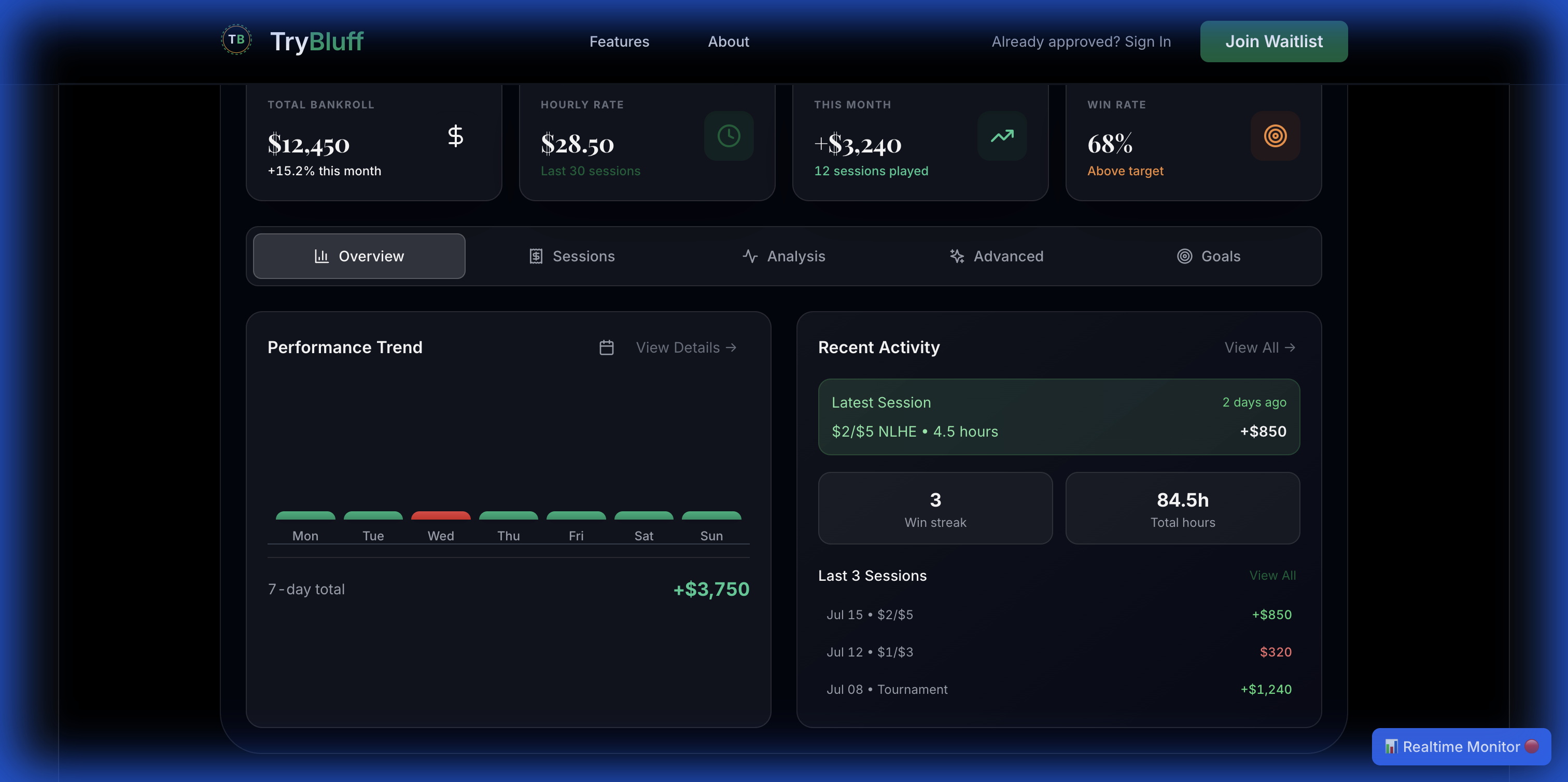
Logging a Session in TryBluff (Step-by-Step)
The whole flow takes 60-90 seconds per session.
- Open the bankroll tracker. After logging in, click "Bankroll" in the main navigation.
- Add a new session. Click "Add Session" and fill in date, location (select existing site/casino or add a new one), game type (cash or tournament), stakes, buy-in, cash-out, duration, and optional notes.
- Save. The dashboard updates immediately — total profit/loss, win rate, hourly rate, and the bankroll graph all recalculate.
- Filter and analyze. Use the filter controls to narrow by game type (cash only, tournaments only), specific location (compare online vs live), date range (this month, last 90 days, all time), or stakes level.
- Set goals. Click "Goals" to set targets like "reach $5,000 bankroll by March 1" or "play 100 hours this month." Progress is tracked automatically as you log sessions.
What Metrics to Track
Essential metrics:
- Total profit/loss - Overall results
- Win rate (cash games: bb/100, tournaments: ROI %)
- Hourly rate - Profit per hour played
- Session count - Total sessions logged
- Biggest win/loss - Extreme results
Advanced metrics:
- Standard deviation - Variance measurement
- Downswing tolerance - Worst losing streak
- Best game type - Where you profit most
- Time of day performance - When you play best
- Location performance - Live vs online results
The Psychology of Tracking
Why tracking improves results:
- Accountability - Harder to lie to yourself about results
- Pattern recognition - Spot tilt triggers and timing issues
- Motivation - Seeing progress encourages discipline
- Decision-making - Data-driven stake selection
Common tracking mistakes:
- ❌ Not tracking small sessions ("I'll remember")
- ❌ Rounding numbers or estimating — "$200 in, around $350 out" loses real money over time. Be exact: $347, not $350.
- ❌ Cherry-picking what to log
- ❌ Not including expenses (rake, tips, travel)
- ❌ Forgetting to log when losing
- ❌ Forgetting rebuys — if you bought in for $200 and rebought another $200, your buy-in is $400, not $200.
- ❌ Combining multiple sessions at the same venue into one entry — three sessions at Aria on the same day are three entries, not one. Mental state and table conditions change between sessions.
- ❌ Tournament accounting errors — for tournaments, the buy-in is the entry fee including rake (a $100+$10 event = $110 buy-in), and cash-out is your prize money.
- ❌ Ignoring comps and rakeback — free meal vouchers, hotel comps, and rakeback have real monetary value. Add them to cash-out.
- ❌ Tracking on random scraps of paper — pick one system (notebook, spreadsheet, or app) and stick to it.
Rule: Log every session within 24 hours while details are fresh.
Reconstructing missed sessions. If you forget to log for a stretch, don't just give up on the data. Cross-reference bank account transactions, credit card statements, online site history, tournament confirmation emails, and texts with poker friends ("played at Aria last Tuesday") to rebuild the picture. Approximate data is better than no data — but flag reconstructed entries in your notes so you don't treat them as precise.
Common Bankroll Mistakes
Even experienced players make these critical errors:
1. Playing Above Your Bankroll
The mistake: "I'll just play one $500 tournament even though my bankroll is only $3,000."
Why it's bad:
- One buy-in = 17% of bankroll (should be <1%)
- Puts enormous pressure on you
- One bad beat can be devastating
- Creates scared money syndrome
The fix: Never play a game where the buy-in exceeds 2-3% of your bankroll.
2. Not Separating Poker and Personal Funds
The mistake: "I'll just use money from my checking account when I need to reload."
Why it's bad:
- Hides true results (are you really winning?)
- No clear picture of poker profitability
- Risk dipping into money needed for bills
- Psychological impact of "borrowing" from yourself
The fix: Create a separate account or tracker exclusively for poker funds. Treat withdrawals as "salary" you've earned.
3. Ignoring Variance
The mistake: "I lost 10 buy-ins in two days. I must be playing badly."
Why it's bad:
- Short-term results don't indicate skill level
- Assuming you're bad can lead to unnecessary changes
- Overreacting to variance creates tilt
- Might quit a profitable game too soon
The fix: Evaluate play quality over results. Bad beats happen to everyone. Focus on decision-making, not outcomes.
4. Moving Up Too Quickly
The mistake: "I just won $2,000, time to play higher stakes!"
Why it's bad:
- Short-term wins don't prove long-term skill
- Higher stakes often have tougher opponents
- Variance can crush you quickly
- Psychological pressure increases
The fix: Follow the 50-buy-in rule. Don't move up until you have comfortable cushion.
5. Not Tracking Sessions
The mistake: "I don't need to track, I know roughly how I'm doing."
Why it's bad:
- You're almost certainly wrong about your results
- Can't identify leaks or profitable games
- No accountability for poor decisions
- Miss patterns in your play
The fix: Track every single session, no exceptions. Use an app to make it effortless.
6. Mixing Bankroll with Living Expenses
The mistake: "I'll use poker winnings to pay rent this month."
Why it's bad:
- Creates pressure to win (scared money)
- Variance means poker income is unpredictable
- Can't afford downswings
- Turns poker into a job, not a game
The fix: Have 3-6 months of living expenses saved separately. Only withdraw from poker bankroll as planned "salary."
7. Chasing Losses
The mistake: "I'm down $500, I need to win it back tonight."
Why it's bad:
- Leads to tilt and poor decisions
- Playing longer than optimal
- Moving up in stakes to "get even quickly"
- Spiral into bigger losses
The fix: Set stop-loss limits. If you lose 3 buy-ins in a session, quit. Tomorrow is another day.
8. No Shot-Taking Plan
The mistake: Random shot-taking: "This $1,000 tournament looks fun, I'll play it."
Why it's bad:
- Unstructured risk-taking
- Can decimate bankroll with one impulse decision
- No criteria for success or failure
The fix: Plan shot-taking in advance:
- Only shot-take with extra 10 buy-ins above threshold
- Risk max 5% of bankroll on a single shot
- Have clear stop-loss (if you lose X, move back down)
Advanced Bankroll Strategies
Once you've mastered the basics, consider these advanced concepts:
Separate Bankrolls by Format
Strategy: Maintain separate bankrolls for cash games and tournaments.
Why:
- Different variance profiles
- Protects one format from the other's swings
- Clearer performance tracking
- Better mental separation
Example allocation:
- $10,000 total bankroll
- $6,000 for cash games (30 BI at $1/$2)
- $4,000 for tournaments (40 BI at $100)
The Kelly Criterion
Advanced math: The Kelly Criterion calculates optimal bet sizing based on your edge and bankroll.
Formula:
Kelly % = (Win Rate × Odds) - 1 / (Odds - 1)
Practical application: Most poker players use fractional Kelly (25-50% of full Kelly) to reduce variance.
Why it matters:
- Maximizes long-term bankroll growth
- Prevents over-betting your edge
- Accounts for uncertainty in win rate estimate
Visualizing Risk of Ruin
As your bankroll grows relative to the buy-in, your risk of going broke drops exponentially. This is why professional players insist on large bankrolls.
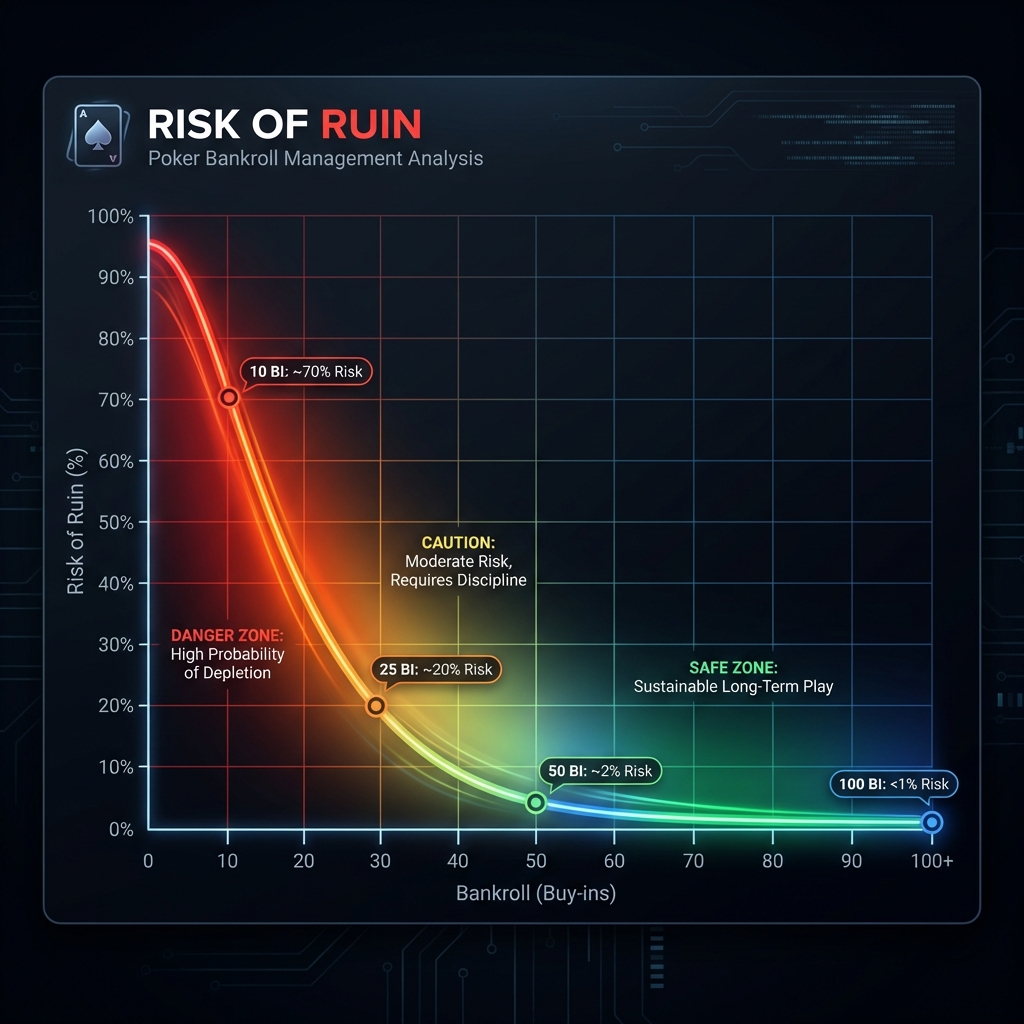
The chart above illustrates how increasing your bankroll from 20 buy-ins to 50 buy-ins dramatically reduces your risk of ruin to near zero.
Bankroll Builder Strategy
For small bankrolls (<$1,000):
- Start ultra-conservative - Play microstakes with 50+ buy-ins
- Focus on volume - Play lots of hands to establish win rate
- Move up aggressively - Once proven, move up with 30 BI
- Withdraw sparingly - Reinvest most profits into bankroll growth
Example path:
- Start: $500 → Play $0.10/$0.25 ($25 BI, 20 BI)
- Win $500 → $1,000 → Move to $0.25/$0.50 ($50 BI, 20 BI)
- Win $1,000 → $2,000 → Move to $0.50/$1.00 ($100 BI, 20 BI)
- Win $2,000 → $4,000 → Move to $1/$2 ($200 BI, 20 BI)
Professional Bankroll Management
For players relying on poker income:
Conservative approach:
- 100+ buy-ins minimum
- Separate "life bankroll" (6-12 months expenses)
- Regular withdrawals as "salary"
- Multiple income streams (coaching, content, media)
The 80/20 Rule:
- Keep 80% of bankroll active for playing
- Hold 20% in reserve for worst-case scenarios
- Never dip into reserve unless desperate
Tax Considerations
Important: Poker winnings are taxable income in most jurisdictions.
Best practices:
- Track all sessions for tax purposes
- Save 25-30% of profits for taxes
- Deduct legitimate expenses (travel, entry fees, software)
- Consult a tax professional
Frequently Asked Questions
How much bankroll do I need to start playing poker?
It depends on your stakes:
| Steak Level | Blinds | Recommended Bankroll | Buy-ins |
|---|---|---|---|
| Micro Stakes (Online) | $0.05/$0.10 | $200 - $300 | 20-30 |
| Small Stakes (Live) | $1/$2 | $4,000 - $6,000 | 20-30 |
| Mid Stakes (Live) | $2/$5 | $10,000 - $15,000 | 20-30 |
Start with stakes where you have at least 20 buy-ins. If you have less, play lower stakes until you build up.
What's a good poker win rate?
Cash games (bb/100 hands):
- Break-even: 0 bb/100
- Small winner: 2-4 bb/100
- Solid winner: 5-8 bb/100
- Strong winner: 8-12 bb/100
- Elite crusher: 12+ bb/100
Tournaments (ROI):
- Break-even: 0% ROI
- Recreational winner: 5-15% ROI
- Solid winner: 15-30% ROI
- Professional: 30-50% ROI
- Elite player: 50%+ ROI
Remember: Sample size matters. You need 30,000+ hands (cash) or 500+ tournaments for reliable win rate estimates.
Should I ever play above my bankroll?
Generally, no. But there are exceptions:
Okay to shot-take when:
- ✅ You have a stable job/income outside poker
- ✅ The game is exceptionally soft
- ✅ You're risking <5% of bankroll
- ✅ You're mentally prepared to lose it
Never play above bankroll when:
- ❌ Poker is your primary income
- ❌ Losing would cause financial stress
- ❌ You're on tilt or playing emotionally
- ❌ The game is tough
How do I know if I'm a winning player?
You need sufficient sample size:
- Cash games: 30,000+ hands minimum
- Tournaments: 500+ tournaments minimum
- Live poker: 300+ hours minimum
Track these indicators:
- Positive win rate over time
- Consistent results across different sessions
- Bankroll growing steadily
- Confidence in decision-making
Warning signs you're not winning:
- Constantly reloading bankroll
- Needing to move down repeatedly
- Negative results over large samples
- Avoiding tracking or analyzing results
What percentage of my bankroll should I risk per session?
Conservative approach:
- Risk 2-5% per cash game session (1-2 buy-ins)
- Risk 1-2% per tournament
Example:
- $5,000 bankroll playing $1/$2 ($200 buy-in)
- 2% risk = $100 → 0.5 buy-ins (tight stop-loss)
- 5% risk = $250 → 1.25 buy-ins (normal session)
Set stop-losses: If you lose 3 buy-ins in one session, quit. Continuing is usually tilt-induced.
How often should I withdraw from my bankroll?
It depends on your goals:
Recreational players:
- Withdraw whenever you want, as long as you maintain minimum buy-ins
- Popular approach: Withdraw profits, keep initial bankroll
Semi-professional players:
- Withdraw monthly "salary" (e.g., 20-30% of profits)
- Reinvest rest into bankroll growth
Professional players:
- Structured withdrawals (e.g., monthly living expenses)
- Maintain 100+ buy-ins at all times
- Have separate emergency fund
Golden rule: Never withdraw if it drops you below 25 buy-ins for your current stakes.
Can I combine my cash game and tournament bankroll?
You can, but it's not ideal.
Pros of combined bankroll:
- Simpler tracking
- More flexibility
- Larger total bankroll
Cons:
- Different variance profiles
- Harder to evaluate performance by format
- Cash game downswing can affect tournament play
Recommendation: If you play both seriously, separate them. If one is recreational, combine them.
What if I lose my entire bankroll?
It happens to many players. Here's what to do:
Immediate steps:
- Take a break (at least 1 week)
- Review what went wrong (stakes too high? Tilt? Bad luck?)
- Study poker strategy and plug leaks
- Rebuild with smaller stakes and conservative BRM
Prevention:
- Follow bankroll guidelines strictly
- Never play scared money
- Have stop-losses
- Take breaks during downswings
Remember: Even winning players can go broke with poor bankroll management. It doesn't mean you're a bad player—just that you need better discipline.
Conclusion: Master Your Bankroll, Master Your Game
Bankroll management isn't glamorous, but it's the difference between poker as a sustainable pursuit versus a quick trip to going broke.
Key takeaways:
- ✅ Maintain 20-30+ buy-ins for your stakes (50+ for tournaments)
- ✅ Separate poker funds from personal finances
- ✅ Track every session without exception
- ✅ Move up conservatively with 50 buy-ins for new stakes
- ✅ Move down immediately if you drop below 25 buy-ins
- ✅ Accept variance as part of the game
- ✅ Never play scared money or above your roll
The math is simple: proper bankroll management gives you the cushion to survive downswings and the confidence to play your best poker.
Start Tracking Your Bankroll Today
Ready to take control of your poker finances? Try TryBluff's free bankroll tracker and start logging sessions in seconds. Track your progress, visualize your results, and achieve your poker goals with data-driven insights.
Features:
- 📊 Automatic win rate and ROI calculations
- 📈 Beautiful graphs showing bankroll growth
- 🎯 Goal setting and progress tracking
- 📱 Mobile app for logging live sessions instantly
- 💰 Tax-ready reports for end of year
Have questions about bankroll management? Join our poker community to discuss strategies with players at all levels.
Related Articles:
- Poker Strategy: The Complete Guide — The master hub linking every TryBluff strategy resource
- Poker Cash Game Strategy: The Complete Guide — Stake-specific buy-in math and 6-max ranges
- How to Track Your Bankroll — practical session-logging methods (jump to section)
- Cash Games vs Tournaments — sizing differences explained (jump to section)
- Common Bankroll Mistakes — leak-prevention checklist (jump to section)
- What Is GTO Poker? GTO Strategy Explained
- ICM Calculator Tutorial
- How to Use TryBluff's ICM Calculator
- Poker Equity Calculator Guide